Koch-Schrift Reduced
TrueTypeDo użytku osobistego
Koch-Schrift_Reduced.ttf
Tagi
Uwaga autora
Heavy blackletter;
Rudolf Kochs first type from 1909
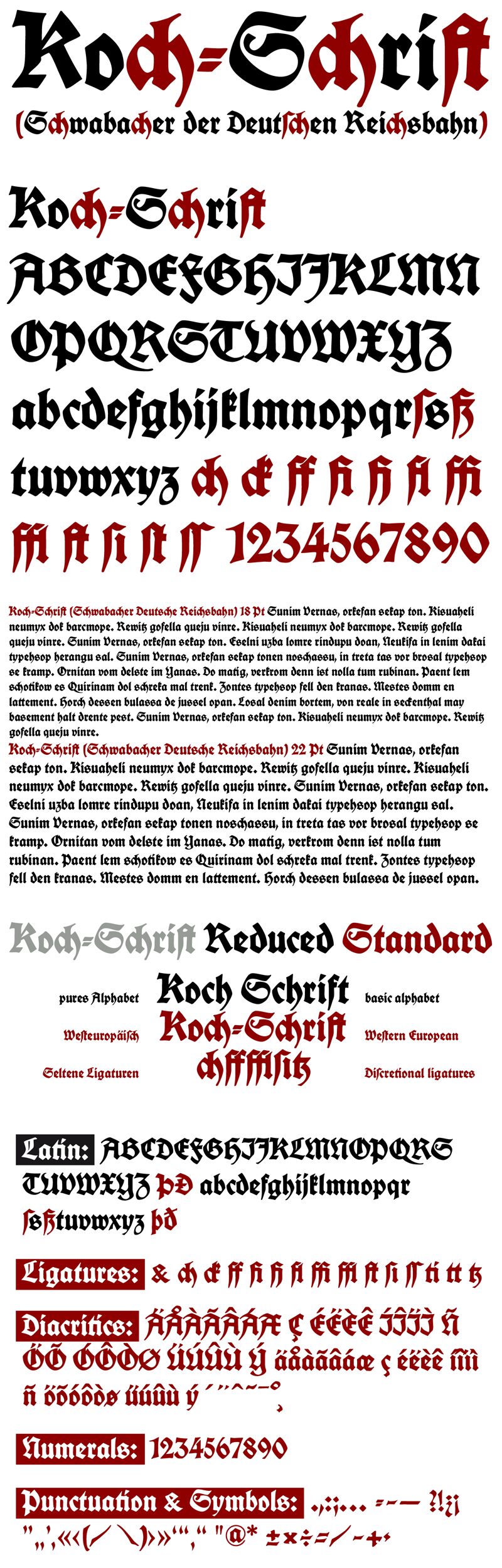
On an old page full of type specimen from the 1930s, the type is described as Schwabacher (used by the Deutsche Reichsbahn [German Imperial Railway]). As a matter of fact, it is the first print of the Offenbach script master Rudolf Koch, who came out with this typeface in 1909.
At that time, it was given the name Neudeutsch (New German). Later, it became very popular under the name Koch-Schrift, and was at times the official typeface of the Deutsche Reichsbahn (German Imperial Railway).
The font downloadable here is a reduced version (without punctuation, ligatures, numbers etc.). A commercial version of this font (with all features) is available at www.ingofonts.com.
Rudolf Kochs first type from 1909
On an old page full of type specimen from the 1930s, the type is described as Schwabacher (used by the Deutsche Reichsbahn [German Imperial Railway]). As a matter of fact, it is the first print of the Offenbach script master Rudolf Koch, who came out with this typeface in 1909.
At that time, it was given the name Neudeutsch (New German). Later, it became very popular under the name Koch-Schrift, and was at times the official typeface of the Deutsche Reichsbahn (German Imperial Railway).
The font downloadable here is a reduced version (without punctuation, ligatures, numbers etc.). A commercial version of this font (with all features) is available at www.ingofonts.com.
Mapa znaków
Proszę korzystać z menu rozwijalnego aby podglądać różne mapy znaków zawierane do tej czcionki.

Podstawowe informacje o czcionce
Prawa autorskie
Copyright (c) 1987 by ingoFont Augsburg Ingo Zimmermann. All rights reserved.
Rodzina czcionki
Koch-Schrift Reduced
Podrodzina czcionki
Regular
Wyjątkowa identyfikacja podrodziny
ingoFontAugsburgIngoZimmermann: Koch-Schrift Reduced: 1987
Pełna nazwa czcionki
Koch-Schrift Reduced
Nazwij Wersję tabelki
Version 2.007
Postscriptowe imiona czcionki
Koch-SchriftReduced
Zawiadomienie o znaku towarowym
Koch-Schrift Reduced is a trademark of ingoFont Augsburg Ingo Zimmermann.
Producent
Projektant
Opis
Copyright (c) 1987 by ingoFont Augsburg Ingo Zimmermann. All rights reserved.
Rozszerzone informacje o czcionce
Obsługiwane platformy
PlatformaKodowanie
UnicodeUnikod 2.0 a nasledovná sémantika, tylko BMP unikod
MacintoshAntykwa (roman)
MicrosoftTylko BMP unikod
Szczegóły czcionki
Stworzony2012-04-05
Korekta2
Liczba znaków53
Jednostki po Em1000
Prawa osadzeniaOsadzania dla stałych instalacji
Klasa rodzinyNieklasyfikowane
GrubośćPółgruba
SzerokośćPodstawowa
Styl MacKursywa
KierunekTylko znaki skierowane od lewej do prawej + zawiera neutralie
Natura wzoruRegularny